
Starting a New Job? Your First-Week Checklist

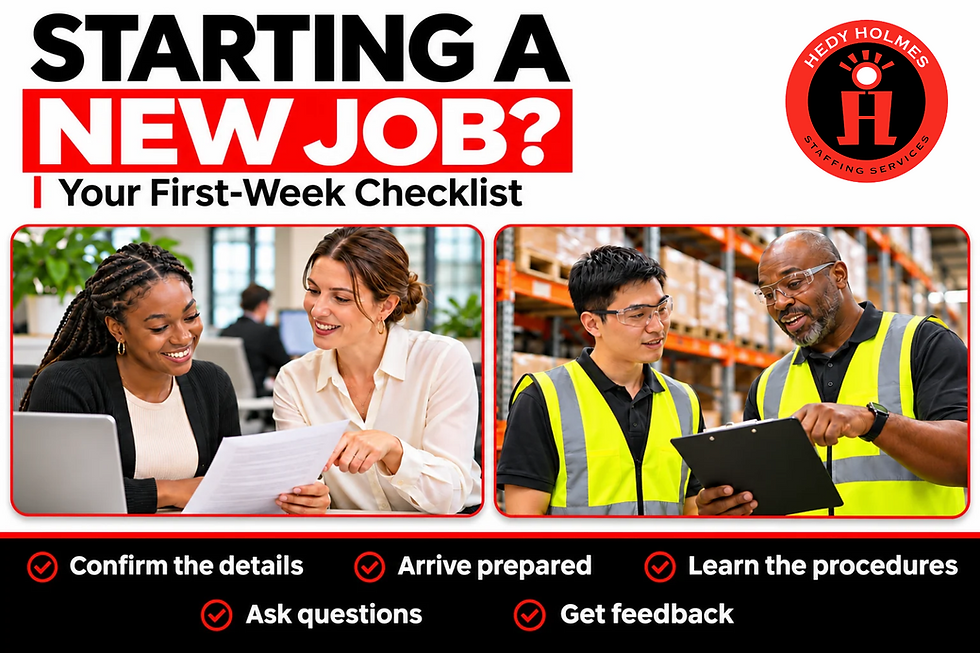
Starting a New Job
Starting a new job brings new people, routines, and responsibilities. It is normal to feel excited and a little nervous, whether you are entering a warehouse, joining a manufacturing team, or stepping into an office position.
You do not need to know everything on your first day. Focus on arriving prepared, learning expectations, asking questions, and developing good habits.
Use this first-week checklist to help you get settled and make a professional impression.
Looking for your next opportunity? Browse available jobs with Hedy Holmes Staffing.
Before Your First Day: Confirm the Details
A little preparation can make your first morning easier. Review your assignment or offer information and clarify anything that is missing.
Confirm:
Your start date and arrival time.
The work address, parking instructions, and employee entrance.
Who you should ask for when you arrive.
Your schedule and expected work hours.
Dress requirements and any required protective equipment.
Documents or materials you have been asked to bring.
Whether you need to bring lunch or have access to food nearby.
Plan your transportation and allow extra time for traffic or finding the correct entrance. If you are working through a staffing agency, keep your recruiter’s contact information accessible.
Day One: Learn the Basics
Your first day is an opportunity to understand how the workplace operates.
Introduce yourself, learn your supervisor’s name, and identify who will provide your training. Keep a small notebook if permitted so you can record instructions and questions without relying on memory.
Before leaving, make sure you know:
How to clock in and out or record your hours.
Where to store personal belongings.
When and where to take scheduled breaks.
Who to contact if you will be late or absent.
How to report a problem or request help.
Where to find the schedule for your next shift.
If your workplace restricts phones or personal items, follow those instructions from the start.
Put Safety and Training First
When starting a new job, learning the correct procedure matters more than trying to appear experienced.
Pay close attention to orientation and role-specific training. Ask for clarification when an instruction is unclear, especially when it involves equipment, lifting, chemicals, or unfamiliar tasks.
Before beginning a task, confirm that you understand the instructions and have any required training, authorization, and protective equipment.
Office employees should also learn procedures for handling confidential records, accessing systems, and protecting company information.
A useful question: “Could you show me the correct process before I try it?”
Days Two and Three: Understand What Success Looks Like
Once you know the basics, learn how your supervisor evaluates the work.
Ask questions such as:
Which tasks should I learn first?
What should I be able to do independently by the end of the week?
How do you check accuracy or quality?
Who should I ask when priorities conflict?
What mistakes should a new employee watch for?
Expectations will vary by position. A warehouse employee may need to learn order verification, while an office assistant may need to understand scheduling procedures and document organization.
Knowing the priorities helps you direct your effort toward the right tasks.
Build Good Communication Habits
Clear communication helps you learn and keeps your team informed.
Listen carefully, repeat important instructions when needed, and ask questions before guessing. If you make a mistake, report it promptly and ask how to correct it.
For example:
“I noticed I entered the wrong quantity. I have stopped processing the order. What is the correct way to fix it?”
If you finish a task, let your supervisor know and ask what comes next. Avoid changing an established process without checking first.
If You Work Through a Staffing Agency, Confirm Your Responsibilities
Your worksite supervisor and staffing agency may handle different parts of your assignment. Make sure you know whom to contact for each issue.
Clarify:
How to submit your hours and who approves them.
Whom to notify about attendance or schedule changes.
Where to direct payroll questions.
How to raise concerns about the assignment.
What to do if the duties or schedule differ from the information you received.
Follow the attendance and reporting instructions provided by your agency and worksite. Do not assume notifying one automatically notifies the other.
By the End of the Week: Ask for Feedback
A short conversation with your supervisor can help you understand your progress.
Try asking:
“Now that I’ve completed my first week, is there anything you would like me to do differently or focus on next week?”
Listen to the feedback, clarify anything you do not understand, and choose one or two improvements to work on.
You can also review your own notes. Which tasks are becoming familiar? Where do you still need guidance?
Your First-Week Checklist
Before the week ends, check that you have:
Confirmed your schedule, location, and reporting contact.
Learned timekeeping and attendance procedures.
Completed assigned orientation and training.
Asked questions about unfamiliar tasks.
Understood your initial responsibilities and priorities.
Learned how to communicate problems.
Reviewed your recorded hours for accuracy.
Asked for feedback and identified your next steps.
Start Your Next Opportunity With Hedy Holmes Staffing
Starting a new job is a learning process. Preparation, dependable attendance, clear communication, and a willingness to accept feedback can help you build a strong foundation.
Take the first week one step at a time. Learn the procedures, get to know your team, and ask for support when you need it.
Ready for a new opportunity? Explore available jobs with Hedy Holmes Staffing and apply for positions that match your experience, interests, and availability.


Comments